
Home / Computer Basics / Windows Course / Lesson 4
Windows Basics - The Start Menu
Difficulty: Easy
Required OS: Windows 11 or another version

The Windows Start Menu

Pour les lecteurs français
Consultez le cours en français : Le Menu Démarrer de Windows
Table of Contents
- Open the Start Menu
- Main features of the Start Menu
- FAQ
1. Open the Start Menu
To open the Start Menu, click the first icon located on the taskbar at the bottom of your screen. You can also open it directly from your keyboard by pressing the Windows key. This key looks like a small window and is usually located between the Ctrl and Alt keys.
Windows → Open the Start Menu
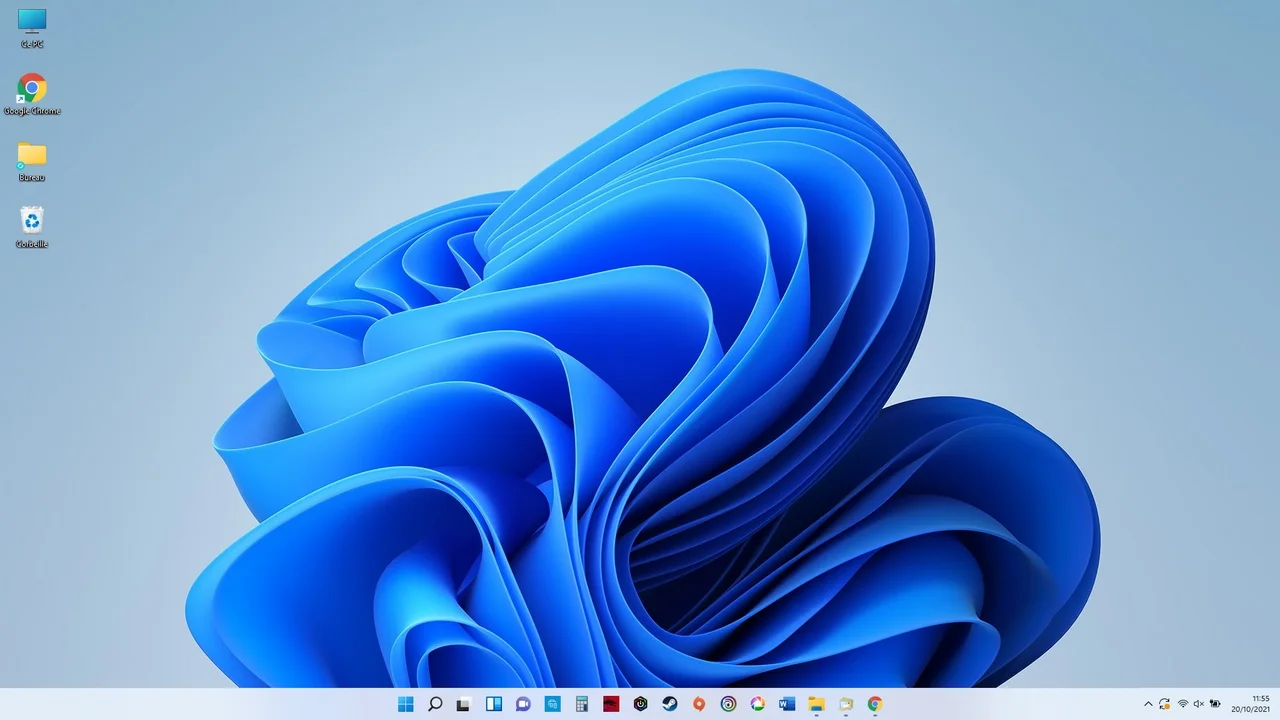
In the previous lesson, we explored the Windows Desktop, including the wallpaper, shortcut icons, and the taskbar. The taskbar itself contains several important features such as the Start Menu, application shortcuts, and system information like battery level, internet connection status, sound volume, date, and time. In the next lesson, we will take a closer look at how the Windows taskbar works.
Let’s take a closer look at the part of the taskbar that allows us to open the Start Menu. To open the Start Menu, simply click the Start menu icon located on your computer’s taskbar. You can also open it quickly by pressing the Windows key on your keyboard.
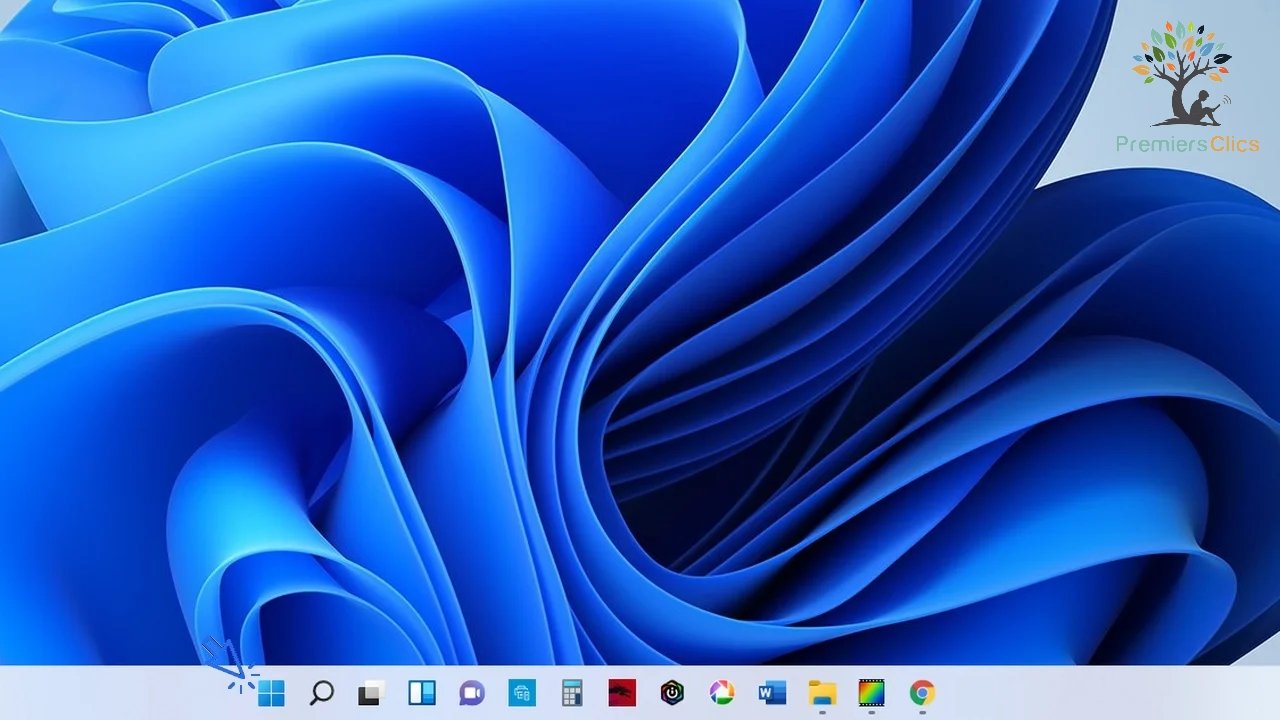
On the Taskbar, click on the Sart Menu Icon, or press the Windows Key on your keyboard
Want to know more about your keyboard ?
2. Main features to the Sart Menu
The Start Menu gives you quick access to most of the important features and tools available on your computer. It is designed to help beginners easily navigate through Windows 11 and quickly find applications, files, and settings.
The Windows Start Menu is divided into four main areas that help you quickly access the most important features of your computer.
The first area (1) is the sidebar located on the left side of the Start Menu. This section gives access to important Windows options such as your Documents and Pictures folders, Windows Settings, and File Explorer. You can also change user accounts, lock your session, put the computer to sleep, restart it, or completely shut down the PC.
The second area (2) displays your most-used applications and the complete list of installed programs. Frequently used apps appear at the top for faster access, while the “All Apps” section allows you to browse every program installed on your computer.
The third area (3) contains useful information and customizable shortcuts. Here, you can view the date, weather, and quick-access tools. This section may also include Cortana or Windows search features to help you quickly find information or launch applications.
Finally, the fourth area (4) is dedicated to entertainment and news. It provides quick access to multimedia applications, recommended content, and the latest news updates directly from Windows.
I have prepared an illustration to help you clearly understand the different parts of the Windows Start menu :
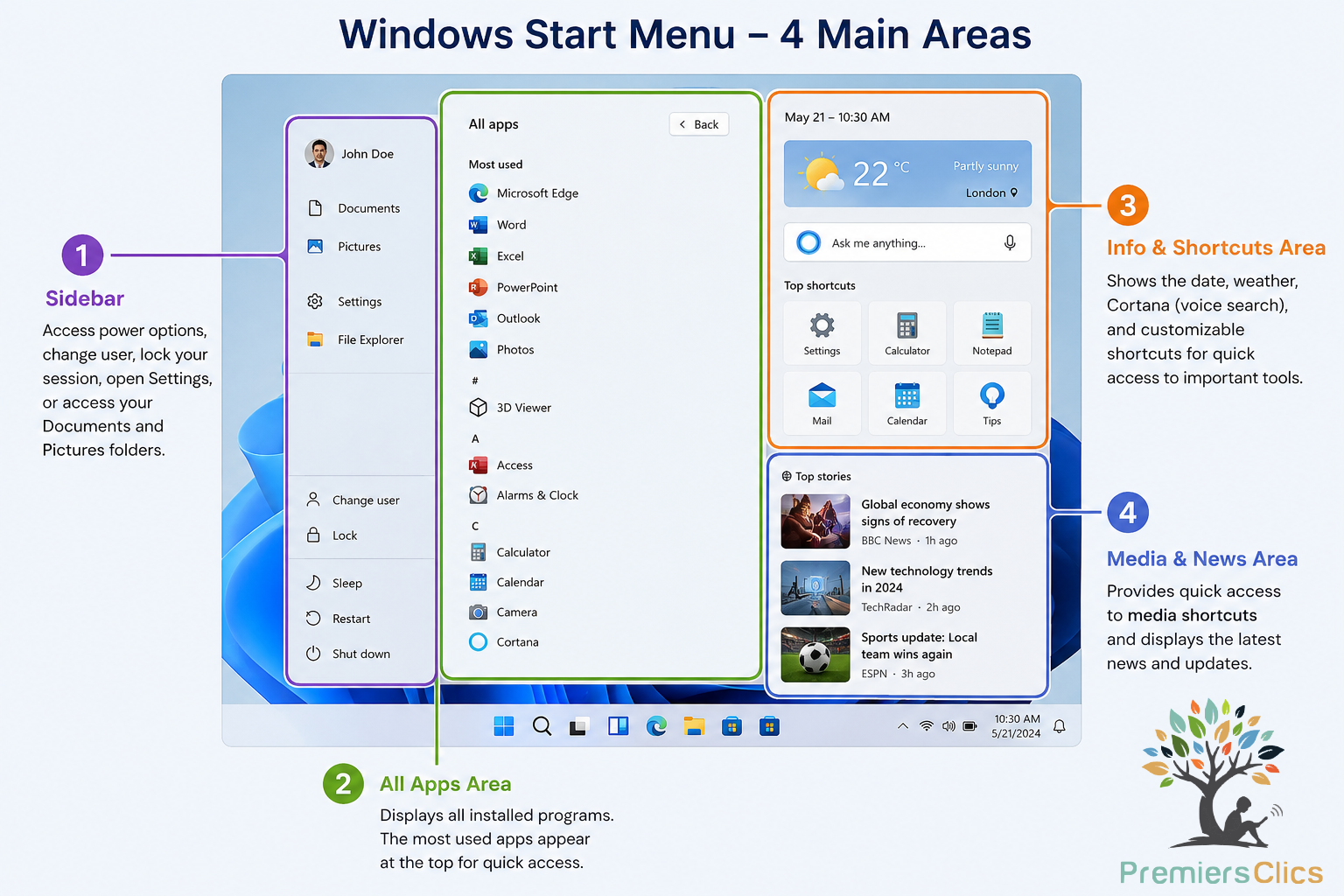
The Start Menu gives you quick access to all the essential features of Windows
from one central place. Click to enlarge the image!
3. FAQ - Windows : the Sart Menu
How do I open the Start Menu in Windows 11?
To open the Start Menu in Windows 11, click the Windows icon located on the taskbar at the bottom of your screen. You can also press the Windows key on your keyboard, usually found between the Ctrl and Alt keys. The Start Menu gives you quick access to your applications, files, settings, and power options, making it one of the most useful features of Windows for beginners.
Why is my Windows Start Menu not working?
If your Windows Start Menu is not responding correctly, the issue may be caused by a temporary Windows problem, a recent update, or a frozen system process. Restarting your computer often fixes the problem quickly. You can also restart Windows Explorer from the Task Manager to refresh the Windows interface. Keeping your computer updated regularly can also help prevent Start Menu issues and improve overall performance. If the issue persists, you'll need to reset your laptop... using the Windows Settings
How do I pin an application to the Start Menu?
To pin an application to the Start Menu, open the Start Menu and locate the app you want to add. Right-click on the application icon and choose “Pin to Start”. The application will then appear in the pinned apps section for faster access. You can also drag and move icons around to organize your Start Menu and keep your favorite apps easy to find.
How can I shut down my computer from the Start Menu?
To safely turn off your computer using the Start Menu, click the Windows icon on the taskbar and then select the power button located in the lower-right corner of the menu. You will see several options, including Sleep, Restart, and Shut Down. Clicking “Shut Down” completely turns off your computer and safely closes all active programs and Windows processes.
What is the difference between the Start Menu and the taskbar?
The Start Menu and the taskbar are both essential parts of the Windows interface, but they serve different purposes. The Start Menu is mainly used to access applications, settings, documents, and power options. The taskbar, located at the bottom of the screen, displays open applications, pinned shortcuts, notifications, internet connection status, sound controls, and the current date and time for quick everyday access.
Conclusion
You now know how to open and use the Windows Start Menu in Windows 11. The Start Menu is an essential part of Windows and allows you to quickly access your applications, files, settings, and power options every day.
In the previous lesson, we explained the Windows Desktop functionality (create and organize shortcuts and folders, change the wallpaper in Windows 11). In the next lesson, you will learn everything you need to know about the Windows taskbar, including how to use application shortcuts, system icons, notifications, and other useful features to navigate your computer more easily.
Click to view all Windows lessons and learn how to use a computer or click the “Next Lesson” button to continue learning. You can also browse lessons using the Computer Course summary.
Thibaut Mathieu
End of the lesson
You have become familiar with the Windows Start Menu.
Similar Articles
- Windows basics : the desktop
- Windows basics : the taskbar
- How to change Windows background
🔹 Computer Basics
🔹 Windows Course
- The Desktop
- The Sart Menu
- Empty Recycle Bin
- Recover deleted files
- Create and organize folders
- Create desktop shortcuts
- Pin a programm on the taskbar
- Compress a ZIP file
- Decompress a ZIP file
Organize files and folders
Customize your desktop
- Make a screenshot
- Make file and folder icons bigger
Understand the start menu and taskbar
- Open a downloaded file
- Change Windows Wallpaper
- Take a screenshot
🔹 Internet and Email
Open and use a web browser
- Creating a Gmail email
- How to send emails and attachments
- Browsing history in Chrome, Edge or Firefox
- Browsing download history in Chrome, Edge or Firefox
- Delete history in Chrome, Edge or Firefox
- Delete cookies and browsing data
- Set Google Chrome Homepage
Create and manage an email account
- How access Netflix from Phone, PC or Tablet
- What is a VPN ?
🔹 Computer Protection
🔹 Troubleshooting
🔹 Practical Life
Smartphone Problems: All Simple Step-by-Step Solutions
This may interest you :

Create a Folder

Create an email account (Gmail)
How to create a Gmail account to send and receive emails.
Send emails and attachments
How to send emails and attachments. Example with Gmail.

Recover deleted files
How to recover deleted files in the Windows Recycle Bin.

Change Google Chrome Homepage

Take a Screenshot
See how taking a screenshot in Windows

Increase display size
Create desktop shorcuts
How to create shortcuts on the desktop.

Connect a wifi printer
How connect a printer to your wifi network and how install it in Windows.
Smartphone Tips & Tricks

Connect Bluetooth speakers to phone
How connect a BT device like a speaker to your phone.

Open iPhone Settings app
Tips to help you learn how to open the Settings app on an iPhone.

Solve internet issues
How to fix the main internet connections issues. Main troubleshooting steps.
Common Smartphone Problems

My phone is not charging
What should you do if your phone no longer charges?

I can't make calls
Check this tips if you can't make calls anymore.
No internet on my phone

My phone restarts by itself
Why does your phone restart by itself and how to fix it.

Thibaut MATHIEU
Editor of Premiers Clics
Editor and writer of Premiers Clics, and author of the book “Je me mets à l'informatique” (only avalaible in french), I share all my computer knowledge to help you learn, using the Premiers Clics computer courses.
Also the manager of a computer support and repair company, I fully understand your needs in computer training and assistance. Every day, I answer my clients’ questions about their computers, phones, or tablets.
This experience has given me extensive knowledge in consumer digital technology, allowing me to separate fact from fiction in device protection, identify the most common user mistakes, and provide numerous tips to make the best use of PCs, smartphones, and tablets.

0 commentaire